The AI Visibility Gap
Why established brands must stay visible above the fold in AI-generated results — and what happens when they don't. A controlled experiment with 604 participants reveals the true cost of displacement.
Executive Summary
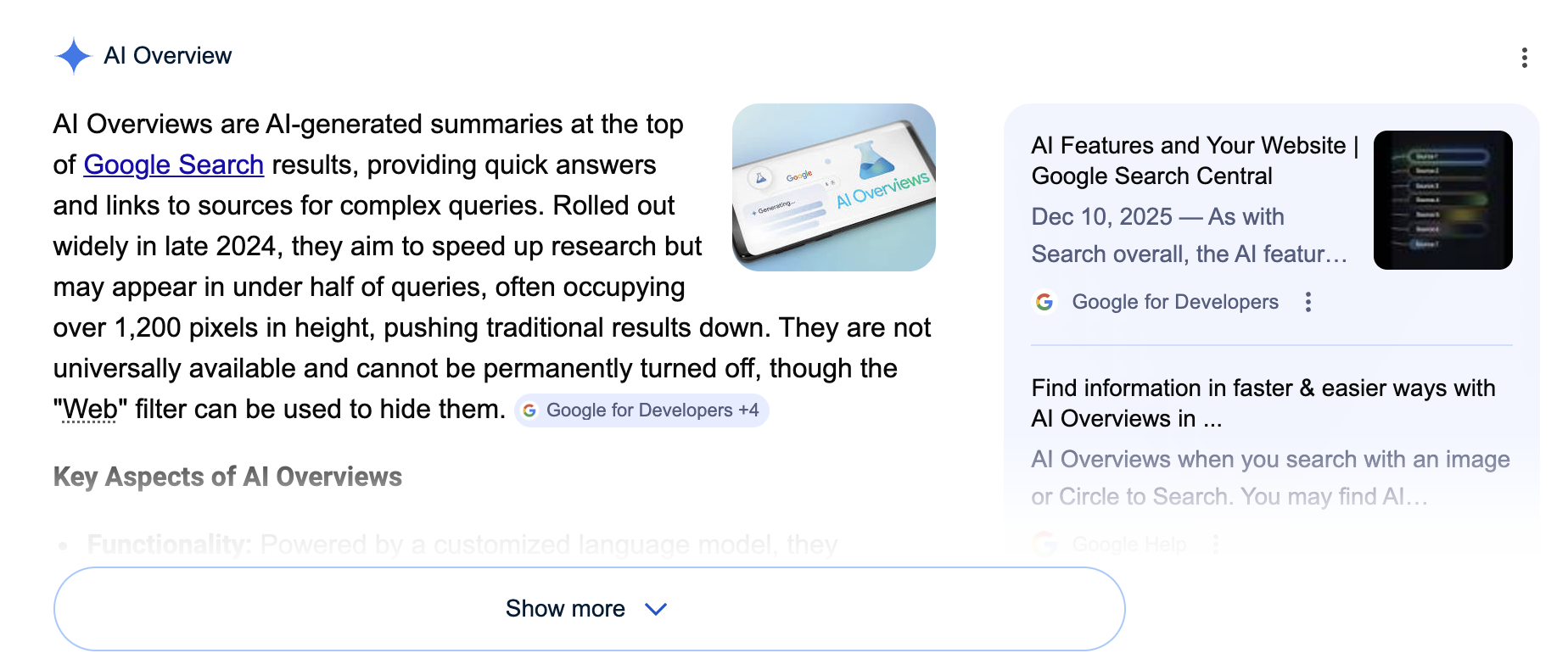
As AI-generated overviews (AIO) transform the search engine results page, brands relying solely on organic positioning face new risks. Based on a controlled experiment with 604 participants in the dog food category, this study reveals four critical findings:
- Displacement damages loyalty: When a brand is pushed below the fold, repeat purchase drops by more than 50%.
- Most users never look below the fold: Approximately two-thirds never click "Show More" — rising to 91% when text ads are present.
- The AIO is a confirmation engine, not an acquisition tool: AIO presence increased repeat purchase for the leading brand while simultaneously decreasing first-time purchase. The AIO validates existing choices — it does not create new ones.
- Paid Search can recover lost value — but only through clicks: Text ad impressions alone show zero improvement; the ad must earn the click to deliver results.
The Challenge: Displacement Below the Fold
When brands fall below the "Show More" toggle in an AI Overview, they effectively disappear. Approximately 66% of users never expand the list — and among those who don't, displaced brands show sharp declines across the purchase funnel:
- −8.9% point drop in Repeat Purchase, statistically significant (p = .015), representing a greater than 50% decline in loyalty-driven buying.
- −7.2% point drop in Purchase Intent (directional)
- −7.5% point drop in Brand Favorability (directional)
Why Displacement Hurts: The AIO Reinforces Loyalty — It Doesn't Build It
Displacement is especially damaging because the AIO only works for consumers who already know your brand. It reinforces existing preferences — it does not create new ones. The evidence:
- Repeat purchase increased when brands appeared prominently in the AIO. For the brand with the largest loyal customer base in the study (Purina Pro Plan), repeat purchase increased when the AIO was present (+6.6pp, p = .030), consistent with a validation effect among existing customers.
- First-time purchase declined when the AIO was present — even though the AIO explicitly named and recommended those brands for the first time in the search experience. For Purina Pro Plan, first-time purchase fell from 10.0% to 4.2%, a significant −5.8pp decline (p = .048). Hill's Science Diet showed a similar directional decline (−1.1pp) but did not reach significance.
Key insight: The AI Overview functions as a confirmation engine — consumers who already know a brand see Google's recommendation as validation. Consumers who don't know the brand are not converted by the recommendation alone.
This confirmation effect has a corollary: the AIO cannot create brand awareness from scratch. We promoted two niche brands to the first position in the AI Overview:
- JustFoodForDogs: Zero purchases across all conditions, despite being promoted to first AIO mention.
- PetPlate: No significant movement on any metric despite prominent placement.
The pattern is consistent across all levels of brand equity. Established brands with measurable purchase activity saw the AIO reinforce loyalty but fail to drive acquisition. Smaller brands with low baseline purchase rates generated too little first-time activity to even estimate an effect. And niche brands with near-zero awareness saw no movement at all. Together, these findings point to a clear role for the AIO: it is a powerful reinforcement mechanism for brands that already have equity, and essentially invisible for brands that don't.
Can Paid Ads Recover the Damage? Yes — But Only Through Clicks
When Paid Search text ads are deployed above the AI Overview, they act as a critical safety net. But the mechanism is specific: users who saw a text ad but didn't click it showed zero improvement over the displaced group on any metric. The ad must earn the click. Among users who clicked, the recovery was substantial:
- Purchase Intent Recovery: Ad clickers showed 67.0% Purchase Intent, significantly higher than both the displaced group (49.3%) and non-clickers (49.6%) — a +17.7 percentage point lift over the displaced baseline (p = .002).
- Purchase Behavior Recovery: Ad clickers demonstrated a 29.6% Overall Purchase rate, nearly double the 16.6% rate in the displaced group (p = .010).
- The Click Imperative: Non-clickers were statistically indistinguishable from the displaced group across every metric tested, confirming that passive ad exposure does not offset displacement. Ad creative must be compelling enough to drive the click to capture this value.
The Toggle Suppression Effect
The same text ads that recover performance also change user behavior in a way that makes displacement even worse for brands that don't run ads:
- Without text ads: 34–36% of users expanded the AIO brand list.
- With text ads: Only 9% expanded the list. When paid ads appear above the AIO, users treat the above the fold content as sufficient and nearly all skip the detailed brand list below.
The implication: The 66% non-expansion rate observed without ads is the optimistic scenario. With ads present, invisibility may approach 91%. For brands considering paid search as a displacement hedge, this creates a paradox: the very ads that recover your performance also suppress the toggling behavior that would have let some users discover you organically below the fold.
What This Means for Brand Strategy
1. AIO visibility is binary, not ranked
The critical threshold isn't where your brand appears within the AI Overview — it's whether your brand appears above the fold at all. Two-thirds of users never expand the full list when no ads are present, and over 90% skip it when text ads appear above. If your brand falls below the fold, it effectively doesn't exist for most searchers.
2. Protect your loyalists
The AIO's biggest measurable impacts are on repeat purchase and existing-customer validation, not new customer acquisition. Losing AIO visibility means losing the "validation signal" that reinforces your existing customers' buying behavior.
3. The AIO reinforces — it doesn't introduce
AIO visibility validated choices for existing customers but did not convert new ones. First-time purchase did not increase for any tracked brand when an AIO was present, and for the brand with the most baseline activity (Purina Pro Plan), it declined significantly. Brands whose strategy depends on AIO-driven discovery may be overestimating what that visibility delivers in terms of new customer acquisition.
4. Text ads function as a loyalty recovery tool
The recovery observed when text ads appeared above the AIO was conditional:
- Benefits depended on users actually clicking the ad and were concentrated among existing customers.
- Non-clickers showed no improvement over the displaced group.
- For brands with strong loyalty bases (like Purina Pro Plan, where 40% clicked the ad), defensive paid search may be a viable strategy for re-engaging loyal customers displaced from AIO visibility.
5. Start building your AIO visibility strategy now
The costs of displacement are measurable and concentrated where they matter most — among your existing customers. Two actions to consider now:
- Answer engine optimization (AEO) to protect organic AIO placement.
- Defensive paid search to hedge against displacement, treating AIO visibility as a performance metric alongside traditional search rankings.
Methodology
This independent research utilized a 4-cell between-subjects experiment involving 604 U.S. adults who currently purchase products in the dog food category. The study employed Purchased's Observed Purchase Decision (OPD) methodology — rather than relying solely on stated intent, participants were required to identify the specific product they would purchase, navigate to a real retailer, and submit a screenshot of the product to validate their choice.
The study isolated the variables of AI Overview (AIO) placement and Paid Search presence across four distinct conditions:
- Control: Standard organic search results with no AI Overview
- AIO Baseline: AI Overview with brands in their natural placement
- Brand Swap / Displacement: A smaller brand promoted to the first AIO position, displacing the incumbent brand below the fold
- Brand Swap + Text Ads: Replicated displacement but added paid search text ads above the AI Overview for the displaced brand
More Case Studies

Rethinking the Digital Pathway: Should CPG Brands Drive Traffic to Their Own Website or Retail Partners?
A meta-analysis of 16 CPG studies across six markets reveals that driving traffic to brand.com generates 44% more revenue per 100,000 shoppers than sending traffic to retailer.com — despite lower click-through rates.
Learn More
Lights, Camera, Impact: Measuring Brand Sponsorship in Streaming Content
How Purchased used a longitudinal test-and-control methodology to quantify brand and sales lift from a streaming platform holiday special sponsorship.
Learn More
Why Your Digital Campaign Analysis is Probably Wrong
Learn how your company can measure the true impact of its digital ad spend by embracing an omnichannel approach that analyzes online and offline behaviors.
Learn More
The AI Accuracy Imperative for Brands
AI can sometimes generate misleading or inaccurate responses when queried about brands and products. Why this is a problem, and what you can do to protect your brand.
Learn More