Why Your Digital Campaign Analysis is Probably Wrong
Learn how your company can measure the true impact of its digital ad spend by embracing an omnichannel approach that analyzes online and offline behaviors.

The Omnichannel Measurement Gap
With digital ad spend rising over 10% to $209.7 billion in 2022, the importance of effective online advertising cannot be overstated. Yet, an alarming number of businesses may be assessing their digital ad campaign's impact inadequately. At the heart of this issue is a reliance on solely online conversion metrics, ignoring a crucial piece of the puzzle: omnichannel sales.
The Rise of Omnichannel Shopping
Modern consumers no longer belong to just "online" or "offline" shopping camps. In fact:
- 73% of retail consumers use multiple channels to shop
- 81% of retail shoppers conduct online research before buying in store
This blending of online and offline shopping behavior underscores the importance of omnichannel measurement. Despite these facts, many companies rely only on online conversions to assess the impact of their digital campaigns. In fact we found that campaign analysis would be wrong 73% of the time by relying on online conversion only.

The 73% Mismatch: A Deep Dive
To understand the mismatch, we performed a meta-analysis of over 20 Purchased studies in 6 global markets from shoppers exposed to search, video, and display advertising from 2019 to 2023 in the CPG, food & beverage, and technology product categories.
We looked across these studies and found that campaign effectiveness analysis would be wrong 73% of the time by relying on online conversion only. This means that for these campaigns the incorrect conclusion would potentially result in:
- Misallocation of ad budgets
- Missed opportunities to optimize ad spend
- Incorrect understanding of customer behavior
- Lost opportunities in offline sales
Real-world Implications: The 9% vs. 1% Lift
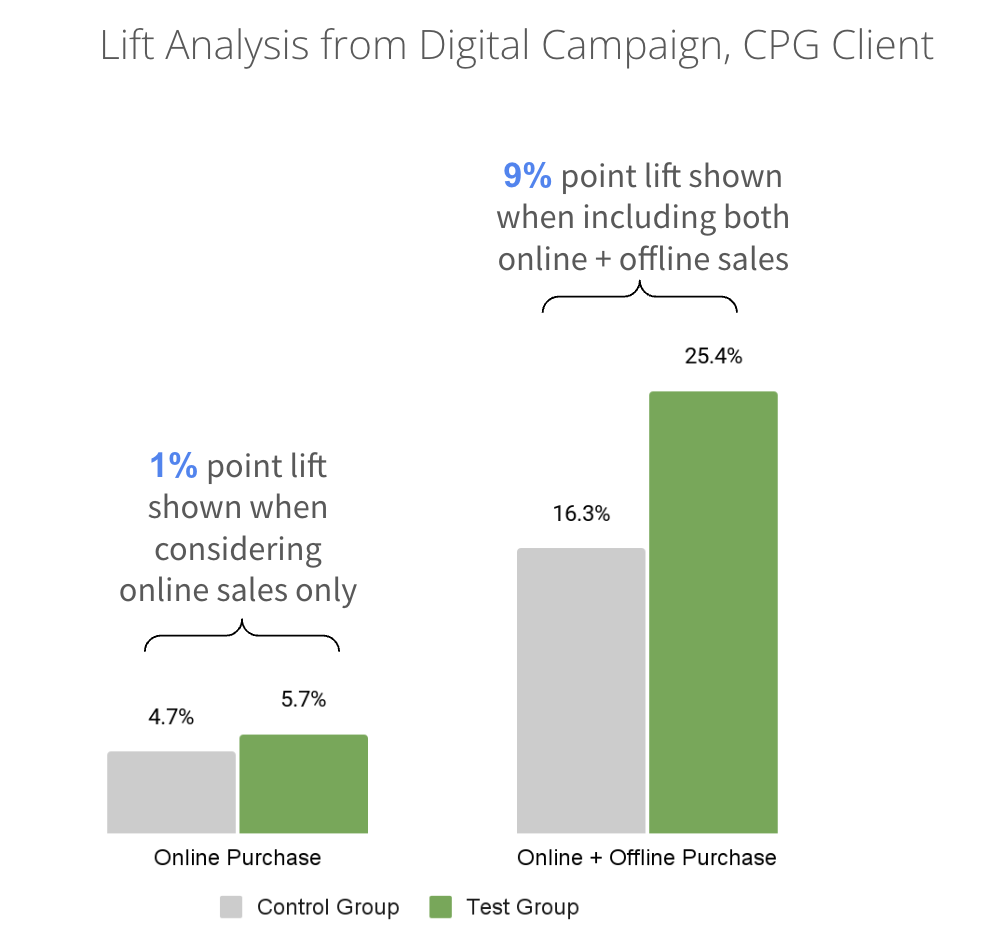
In a recent digital advertising campaign we found that online conversion showed a difference of only 1% point between test and control groups, while the inclusion of offline with online purchases revealed a 9% point lift. But how impactful is this 8% difference in real terms?
Imagine we have 100,000 shoppers exposed to the ads and the Test Ad costs $50,000. Based solely on online conversions, this ad yields a 1% increase in conversion, translating to 1,000 incremental purchasers. If each of these purchasers brings in $10, the total additional revenue from the ad is $10,000. This results in a net loss of $40,000.
However, by including omnichannel sales in our analysis, the Test Ad results in a surge of 9,000 incremental purchasers, generating a total of $90,000 in revenue. Subtracting the ad cost, we're left with a profit of $40,000.
Why Companies Still Rely on Online-Only Metrics
Given its importance, why don't most companies use omnichannel sales to measure the impact of digital advertising campaigns?
- Simplicity and Instant Gratification: With a few clicks, businesses can access a treasure trove of online data. But the journey to understanding true digital impact isn't as straightforward.
- Historical Siloes: Traditionally, businesses operated with separate teams for online and offline sales, each sticking to what they knew best.
- Perceived Cost and Complexity: The integration of online and offline data can seem daunting. Many companies believe that tracking offline impact requires significant investment.
- Misconception About Digital's Influence: A prevalent belief is that online campaigns primarily drive online sales. Such a demarcated view can lead to an underestimation of the holistic impact of digital ads.
Moving Towards Comprehensive Measurement
A longitudinal, omnichannel research approach to marketing attribution and analytics effectively captures omnichannel behavior. This methodology employs a 30-day experimental study on recruited shoppers and captures actual online and offline purchase behavior:
- Define the Objective — Determine the specific impact you aim to study
- Set-up Your Experiment — Create test and control groups to isolate incremental impact
- Recruit Shoppers — Identify and enroll shoppers actively in the market for your product category
- Create a Realistic Digital Environment — Replicate typical customer digital experiences
- Longitudinal Tracking — Continuously track shopper interactions over 30 days
- Capture Online and Offline Receipts — Confirm actual sales to attribute marketing efforts to tangible outcomes
- Analyze and Optimize — Review data and use insights to optimize your digital advertising spend
Conclusion
In an era where digital ad spending has reached unprecedented heights, understanding the actual impact of these ads becomes paramount. The blended shopping habits of contemporary consumers necessitate a shift in how we evaluate advertising success. Embracing a comprehensive omnichannel measurement strategy offers businesses a clear and accurate lens through which they can view their digital marketing's true ROI.
More Case Studies

The AI Visibility Gap
Why established brands must stay visible above the fold in AI-generated results — and what happens when they don't. A controlled experiment with 604 participants reveals the true cost of displacement.
Learn More
Rethinking the Digital Pathway: Should CPG Brands Drive Traffic to Their Own Website or Retail Partners?
A meta-analysis of 16 CPG studies across six markets reveals that driving traffic to brand.com generates 44% more revenue per 100,000 shoppers than sending traffic to retailer.com — despite lower click-through rates.
Learn More
Lights, Camera, Impact: Measuring Brand Sponsorship in Streaming Content
How Purchased used a longitudinal test-and-control methodology to quantify brand and sales lift from a streaming platform holiday special sponsorship.
Learn More
The AI Accuracy Imperative for Brands
AI can sometimes generate misleading or inaccurate responses when queried about brands and products. Why this is a problem, and what you can do to protect your brand.
Learn More